Home » Articles posted by Letter to Britain (Page 53)
Author Archives: Letter to Britain

Is Growth Possible in a Brexit Economy?
“KPMG predicts economic growth of 1.4 per cent next year, but cuts this to 0.6 per cent if Britain leaves the EU without a deal.” — The Times
While some firms predict slower than normal growth for the UK economy in the post-Brexit timeframe, it’s always good to reflect on the assumptions that forecasters employ in creating their reports and why such forecasts can cause more harm than good.
- If you tell your employees that, ‘the chips are down, the economy is sinking, and corporate belt-tightening isn’t far off’ they are likely to respond in a negative way. Some may look for other employment, some will opt for early retirement, while others spend more time in the staff room talking with their coworkers about their employment concerns than getting their work done. Which means such reports can actually cause the negative outcome they’re warning about. It’s human nature to perform to a predicted level instead of trying to exceed expectations. There are few exceptions to this behavior and they are called names like; Olympic athlete, Pulitzer Prize Winner, President, or Astronaut who have the innate ability to ‘power through’ the negative times without losing momentum.
- Such reports deal with known inputs only. For example, a zero-tariff trade deal with the Americans may seem far off today, but by 2020 it may already be signed. And not only the U.S., other political and trade blocs are likely to sign trade deals with the UK following Brexit. The AU (Africa), MERCOSUR (the South American trade bloc), the Pacific Alliance (several Pacific nations), the CPTPP (the Comprehensive and Progressive Agreement for Trans-Pacific Partnership) nations, ASEAN (the Association of Southeast Asian Nations), The Commonwealth (Commonwealth of Nations), and China, are likely to expand their trade links with the UK after it departs the European Union. America and those seven trading areas will have a combined total of 7.0 billion people by 2020. That’s a lot of potential consumers, and the massive opportunities presented by signing zero-tariff trade deals post-Brexit are absent in most economic projections by design. Even if the UK were to sign only one free trade deal (with the U.S., for example) it could improve UK growth by a full 2 per cent or more. Presto! A shiny new UK economy!
- “Now we’ve got them!” While economic forecasting provides vital information for policymakers, Brexit negotiators aren’t helped by the news that growth will slow even in the face of a ‘good Brexit deal’ and will slow moreso in a ‘no Brexit deal’ scenario. It’s the kind of report that makes Michel Barnier’s day! KPMG is certainly one of the most respected firms around, but if you’re a Brexiteer and a report like this has been released to the public instead of it remaining in the hands of policymakers it plays with your mind; “Are they working for the UK’s best interests or are they working for the EU’s best interests?” (and) “Who commissioned (who paid for) this report and what parameters were used?”
So, while the good people of KPMG do their best to provide policymakers with the best near-term assessment of the UK economy, making such reports public can actually cause the negative things to occur about which the report warns.
That’s why policymakers everywhere must be ahead of the curve and treat all such documents as ‘the worst-case scenario’ without exception.
Now that UK Prime Minister Theresa May has been reliably informed that the worst the UK can do is 0.6 per cent growth between now and 2020, it should be an easy matter to arrange a number of free trade deals and blow the doors off that projection by 3 or 4 per cent by 2020.
Looking at this in the proper context means accepting that exiting the European Union is merely a necessary stepping stone to get the UK to 4 per cent growth by 2020 — which should result in Theresa May keeping the PM’s chair for at least one more term and with all past ‘political sins’ forgiven.
Not a bad deal Theresa, if you’re up for it! :)

How Canada and the UK Could Work Together post-Brexit
Until the official Brexit date of March 29, 2019 the UK remains in the European Union — which means that Britain remains a party to the Comprehensive Economic and Trade Agreement (CETA) between the EU and Canada.
And the CETA accord is a very fine agreement (as it should be, because it took 7-years to negotiate) but it may take another year or two to become fully implemented. At the moment CETA is only partially implemented, but eventually 98% of tariffs between Canada and the EU will be eliminated.
Once Brexit happens on March 29, 2019, the UK will cease to be a CETA signatory and something else (a ‘drop-in’ agreement) will need to replace it.
That is the topic of this blog post.
Enter the United States, Canada, and NAFTA.
Where’s Canada on the International Trade Map?
Canada is a surprisingly strong exporting country. With a population of only 36 million and a territory that measures 3.855 million square miles, it means the country is practically empty.
Across this huge landscape are fields of crops larger than the entire UK, but Canada’s few cities are large. In fact, the Greater Toronto Area (the GTA) is larger and has a greater population than the New York Metropolitan Area.
And it’s an exporting superstar; Making it the 11th highest exporting nation in the world.
“Canada is currently the fourth largest exporter of cars in the world and the ninth largest auto producer in the world, making 2.1 million cars a year. Trade with the U.S. is by far the most powerful driver for the automotive sector.” — Export Development Canada
What if There’s No New NAFTA Agreement?
If the NAFTA agreement falters due to insufficient efforts between U.S. and Canadian negotiators Canada will end up producing cars for itself — which means it won’t be exporting 1.8 million cars to the United States annually once NAFTA is terminated (or) once President Trump slaps a 25% tariff on Canadian cars exported to the United States.
Which means a lot of Canadian autoworkers are going to become unemployed the day after that announcement.
Which means that Canada (insert drum roll here) needs a ‘Plan B’.
President Trump Isn’t ‘Being Evil to Canada’ He’s Protecting American Interests Because That’s His Job!
You can’t blame him for that. For goodness sake he’s the President of the United States, not of Canada.
But Canada can’t sit idly by and wait for the world to end. The country must pick itself up and get on with business.
And the best way to do that is to respectfully approach the UK and inform them that it’s likely NAFTA will be terminated or changed in ways that result in Canada having an excess auto manufacturing capacity of up to 1.8 million units per year.
Such manufacturing capacity could be very useful to the UK government and to UK industry.
How Canada and the UK can Work Together for Mutual Benefit
The cost of living in the UK is much higher than it is in Canada, therefore wages in the UK are higher than in Canada.
And it’s the reason why only premium car lines are built in the UK where the high labour cost for exceptional hand-built cars are reflected in the final price and nobody minds paying extra. See; Aston Martin, Jaguar, Land Rover, etc.
Even Rolls Royce and Bentley were forced to move to continental Europe because they couldn’t afford the high labour costs of UK workers and the costly land/building/business costs of manufacturing cars in the United Kingdom.
Post-NAFTA, huge opportunities exist for Canada to export lower-priced GM, Ford, and Fiat Chrysler (FCA) cars and trucks to the UK — freeing-up huge amounts of disposable income for Britons.
Which means that saved money will be spent elsewhere in the UK — whether on home renovations, tuition, school supplies, vacations or investments — because it isn’t going anywhere (it isn’t going to magically vanish!) it will simply be spent on other items.
Any Canadian-built vehicles that are exported to the UK over what the UK market can sustain can be forwarded to Commonwealth of Nations countries by UK re-exporters.
India alone has a population of 1.32 billion and its economy is rising fast to become the third-largest consumer economy in the world. There’s no lack of demand for cars and trucks in the Commonwealth.
A Must Read: India Poised To Be Third Largest Consumer Economy (Forbes)
All of which works to help the UK economy.
Trump Wins, Trudeau Wins and May Wins!
President Trump wins because he will have prevented Canada from exporting 1.8 million vehicles to the United States annually, and American factories (meaning American workers) will need to fill that demand gap, Prime Minister Trudeau wins because he will have saved the Canadian jobs associated with the manufacturing of those 1.8 million cars and trucks, and Prime Minister May wins because she will have ushered in three new lines of lower-priced vehicles for UK consumers and those savings will translate into higher levels of disposable income for British consumers that can be spent elsewhere in the UK economy.
It’s so easy when you know how...

Battle of the Fishing Boats
Fishing boats from France and the UK clash in International Waters Off the French Coast
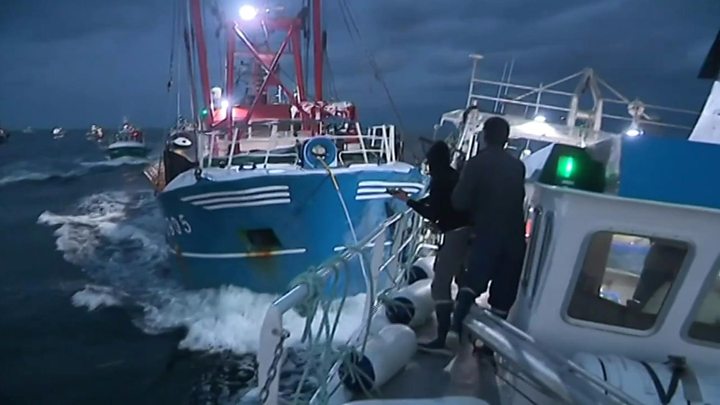
Fishing boats from France and the UK clash in international waters off the French coast. Image courtesy of BBC.
While my head is with the British fishermen attacked yesterday for legally scraping for scallops in international waters, my heart is with the French fishermen who illegally attacked the British fishing boats.
It seems the French government passed a law that only French fishers must obey, but those French fishermen and fisherwomen were upset (inexplicably… not at their own government, but at the British fishers who were merely exercising their legal right to harvest scallops in international waters) and chose to throw large stones at the British boats and crews (breaking some windows in the UK fishing boats) and (dangerously) shot flares across the decks of a British fishing vessel.
It needs to be said again, that the British fishers were operating legally in international waters and following all EU and UK laws.
French law has only the power to restrict French scallop fishermen and fisherwomen — and the actions of the French crews aren’t acceptable in a civilized world.
If French fishers have a problem with French law… they need to take it up with the government of France. Full Stop! (Arrêt complet!)
Yet Another Reason to Exit the EU and the Common Fisheries Policy (CFP)
If UK fishers are expected to follow all relevant EU laws (and they do) but French fishermen aren’t expected to follow all relevant EU laws (and they don’t — that’s now proven by these latest acts of violence and intimidation) how is that fair to the British?
Fishing in UK Waters
When EU and UK fishers operate in British waters they must follow all relevant EU and UK laws even if they must toss millions of tonnes of dead fish overboard every year — because under EU law — if the fish are not of a certain size they must be thrown back (dead or alive) into the water. Which has a devastating effect on the UK fishery and the larger North Sea fishery. How could it not?
And French (or other EU boats) are never attacked by UK fishermen in international waters nor in UK waters…
Fishing in International Waters
Yet for some reason, French fishermen feel they have the right to threaten and assault UK fishers and damage British fishing vessels that are operating legally in international waters.
That’s a stark difference in mindsets between UK fishers and French fishers…
And it’s called ‘entitlement’.
French fishers feel they can assault UK fishers because they feel ‘entitled’ to do so — even though the UK boats were operating in international waters and were following all relevant fishing laws of the EU and the UK.
It’s certainly not the fault of UK fishers that the French government banned French fishers from scallop fishing from May 15 to October 15!
Feelings of ‘entitlement’ by French fishermen and fisherwomen is perhaps symptomatic of a larger problem throughout the European Union; EU citizens feel ‘entitled’ while UK citizens feel they themselves must always follow the law. See the difference in mindsets?
Perhaps it’s just one of many reasons that the first time Britons got a chance to vote on EU membership they voted to Leave… but I’m sure that reasoning (causality?) was lost on those French fishermen during the heated exchange at sea.
Let’s hope the UK fishers take the French fishers/vandals to the European Court of Justice (ECJ) and that damages are awarded to the innocent UK fishers. If not, we’ll know that the EU doesn’t practice what it preaches…
 Letter to Britain