Home » Articles posted by Letter to Britain (Page 50)
Author Archives: Letter to Britain

Let’s Talk Customs Union!
In the European Union, it’s all about the money.
For if it isn’t the EU holding-up the UK for £40 billion to leave the EU, it’s the European Union wanting billions for a Customs Union deal that will benefit continental Europe moreso than it will benefit the United Kingdom.
- To be fair, there’s no word yet if there’s an up-front-payment component associated with the rumoured Customs Union deal.
- Let’s not forget that the £40 billion number was arranged to pay an estimated £9.15 billion in British expat pension and other legitimate liabilities that the UK will rightly owe to the EU over the next 50-years.
- Nobody in the UK disputes the £9.15 billion number (although everyone agrees it’s an approximate number as expat lifespans rise and other legitimate costs could increase in the future) but some wonder how £9.15 billion became £40 billion.
As much as UK citizens are tired of paying a (net) £8.6 billion annually to feed the EU’s budget, it looks like there will be a cost for a Customs Union deal with the EU. Still, few Britons would begrudge paying reasonable amounts (like Norway does) to be in a Customs Union (but not in a Political Union) with the EU.
Just make sure it costs less than £8.6 billion annually, Ms. Prime Minister…
For the record, let’s see how much the UK was projected to contribute to the EU budget

This statistic presents the net contributions that the UK is predicted to make to the EU budget from 2016 to 2022. The peak of contributions is expected to be in 2019/20 at net 12.2 billion British pounds. Find more statistics at Statista.com
If you’re handy with a calculator, you’ll see that’s a net contribution of £71.6 billion over a span of 7-years and you’ll also note that the average net contribution will rise to £11.1 billion annually when averaged over the next 5-years. The £8.6 billion figure that we often hear came about from the average net contribution over the past 5-years.
Wow, that’s a lot of net contributing. Remember, the term “net” means you’re paying more in than you get back.
Time for the EU to Lower Their Spending or (better) Turn EU27 Nations into Net Contributors
Some blocs have ‘champagne taste and wildly varying contributions from member nations’ and the EU is surely that.
Once the UK leaves the union it will be primarily Germany propping-up the bloc as most of the EU27 are net ‘takers’ from the EU budget — and the few net ‘contributors’ are small countries that couldn’t float the EU budget no matter how hard they would try.
Sweden has a great economy for example, but with a population of 9-million people how could they afford to pay for the programme spending of 450 million EU citizens? To cover the EU budget you need two economic near-superpowers. Italy is still putting itself back together after the last recession and France’s economy is a break-even proposition — although the French live very good lives, and good for them. No wonder Germany enjoyed splitting the EU’s bills with the UK since 1993, but especially since 1998. Ultimately however, Germany got plenty of say in EU affairs while the UK was (basically) allowed to comment on EU affairs. But the UK knew that going in, so no complaining!
Let’s see how committed Germany remains to the EU project 5 or 10-years on when it is paying into the EU budget without Britain’s help. German taxpayers and German business might force the country’s politicians to pull out of the EU and amp-up the stature of the EuroZone into a full political and economic bloc. That might be a smart move for EuroZone countries, but it could result in disaster for some non-EuroZone nations.
In the meantime, let’s hope the EU manages to tame its spendthrift ways or that it finds ways to turn ‘taker’ member nations into ‘contributor’ member nations before the EU loses one of its best annual contributors.
That would also have the benefit of helping the keep the continent’s number one economy (Germany) flying high — which is uber-important because one of the things Germany’s robust economy is financing via their contributions to the EU budget is continued peace and prosperity in Europe. And judged by that standard over the past 70-years both Britain and Germany deserve a truckload of Nobel Peace Prizes. Jolly good, gute Freunde!
Until the Brexit implementation period ends in a little over 2-years, the UK must continue paying a net £11.5 billion annually (2019-2021) and it will still need to pay the expected £9.15 billion in expected future liabilities (which for some as yet unexplained reason was trotted-out as £40 billion) and is payable up-front, and it looks like it must also pay to gain or be in a Customs Union agreement with the EU.
As Theresa May has said many times, ‘Nothing is agreed until everything is agreed’ which may yet prove to be among the wisest words a British Prime Minister ever spoke.
Interesting times, indeed.

Brexit & Customs Union – The New Brexit Deal?
UK Prime Minister Theresa May continues to reach out to the EU in order to obtain a workable Brexit deal for both sides. As of today, she’s planning to offer a Brexit deal whereby the UK would stay in a Customs Union with the EU for a specified time in order to give negotiators the time they need to iron out their differences on the Northern Ireland question and other Brexit matters.
Some genuinely admire Ms. May’s efforts in this regard but wonder if she has spent too much time and effort ‘pitching’ to the EU without getting anything in return. It seems for all her good intentions all the EU side says is, ‘No’, ‘No’, and more ‘No’.
Indeed, that’s all they’ve been doing — the more Theresa May offers, the more the EU wants!
And unless the EU side suddenly gets more reasonable it’s going to end badly for both sides.
Is Brexit + a Time-Limited Customs Union Agreement Brexit In Name Only?
For hardline Brexiteers, such a capitulation (for that is how they will surely see it) would be considered a so-called BRINO (a Brexit In Name Only) and is worth much less to them than a so-called Hard Brexit where the UK would leave without the benefit of an agreement with the EU and the UK would be free to embark on any path it chooses.
The EU’s intransigence feeds this feeling among Brexiteers and it seems to be catching-on with moderates in recent weeks.
But there are positives to such a Customs Union plan.
It’s worth noting at this point that negotiators on both sides have been working to create a workable Brexit deal for 2-years and 4-months and have precious little to show for it. The combined total successes are zero and the European default to ‘Low Ambition’ is on full display. Yes, very European.
Yet, responsible leaders continue to throw themselves into finding a Brexit plan that works for both sides. For which they get nothing but abuse and insults on both sides of the English Channel. Shameful.
In the end, obtaining a Brexit deal that results in the least amount of disruption to both economies is the best outcome. And if that means the UK continues on in a Customs Union with the EU for 2-years to give negotiators the time to arrange a suitable Brexit deal — one that includes a proper Northern Ireland agreement — it’s worth the effort.
In the case of failure to reach an agreement for Northern Ireland and other Brexit issues, then a Hard Brexit would remain the only option.
But at least the UK will have put its best effort into obtaining a workable Brexit and any blame for that failure will fall squarely on the European Union as the facts will show Theresa May has been working diligently on the Brexit file through her entire Premiership and has been bending over backwards to find a suitable deal over the past 2-years, while the EU side has been cross with Ms. May for having the temerity to listen to UK voters.
If May Presents a Time-Limited Customs Union Plan, MP’s Should Support It
As they say here in North America, if you give the Europeans a week they’ll take a year and still be a few days late, just on principle.
The same holds true with negotiations: Look at the CETA deal that Canada and the EU negotiated. SEVEN YEARS! (And it’s still not fully implemented)
If the Canadian government had allowed it to go on and on it might have been 2025 by the time it was ready to sign. It seems someone on the Canadian side got a little bossy with the Europeans. Thank you Chrystia Freeland! (Canada’s excellent Foreign Minister) Eight years on, CETA is only partially implemented and none of the EU27 have ratified it. Historic Low Ambition!
Under no circumstances should a UK government ever enter into non-time-limited negotiations with any party, especially with the European Union.
You see what Theresa May is up against?
If there isn’t a strict time limit, the wheeling and dealing will go on forever. And with Theresa May’s well-intentioned but naive personality if it isn’t strictly time limited, by 2025 she will have negotiated away every bit of UK territory, wealth, and rights to the EU — which still won’t be enough for the EU side.
And if that is true, what is the benefit of dragging out negotiations over many years when putting them on a strict timetable will either timeforce an agreement on both parties or allow the UK to get on with creating a better future for Britons free of EU constraints.
Related Article:
- May agrees to curbs on trade to break Brexit deadlock (The Times)

Why the UK Should Match Canada’s 15% Corporate Tax Rate
Canada’s corporate tax rate remains at 15% and that low tax rate was one of the reasons the country essentially cruised unharmed through the financial crash of 2008 and its bloody aftermath.
Throughout the global financial meltdown Canada easily led all G7 countries in growth (although Canadian growth was curtailed as compared to pre-crash projections) and the country didn’t need to increase taxes, nor make major fiscal or monetary adjustments during that period.

Corporate Income Tax Rates for Canada in 2018. For active business income — includes all rate changes announced up to June 15, 2018. Information courtesy of www.EY.com
Although the country isn’t thought of as an offshore tax haven by any stretch, having a 14.5% corporate tax rate during the global economic crisis (it’s since risen to 15%) meant the country avoided the exodus of capital that other nations experienced.
That reasonable corporate tax rate as much as any other factor helped Canada to survive and thrive in the face of one of the most damaging economic meltdowns in modern history.
Money fleeing the country to low corporate taxation destinations is NOT what the UK government needs any time over the next decade.
Will There be Another Recession?
Of course there will be another recession. Recessions in Western countries occur every 25-years on average although unexpected economic shocks have been known to occur. Just because the average interregnum is 25-years, doesn’t mean recessions can’t also happen randomly — which means that the UK needs to begin playing it smart, now, to better survive the next global downturn.
Why Match Canada’s Rate?
Canada’s corporate tax rate just happens to fall within an economic ‘sweet spot’ — high enough that it doesn’t get named and shamed as an offshore tax haven (which tend to get a lot of bad press when a recession is on) yet is close enough to other developed nation corporate tax rates that it doesn’t get a bad reputation.
All else being equal, you want to go with what works. And Canada’s low corporate taxation plan worked wonders to help the country coast through the last recession — and it performed even better than expected, pre- and post-recession.
Sure, there were nervous moments here and there, nobody denies that. But that 15% rate combined with a steady hand on the economic tiller by Mr. Mark Carney then-governor of the Bank of Canada (now governor of the Bank of England) and the country under the steady leadership of (then-Prime Minister) Stephen Harper added gravitas and confidence to the Canadian economy at a time it was needed.
That’s all it takes to survive and thrive in recessionary times, folks.
Philip Hammond’s Next Budget
UK Chancellor of the Exchequer Philip Hammond should match Canada’s corporate income tax rates exactly, and publicly commit to that at Spring Budget 2019. Or even better, in Autumn Budget 2018.
Due to Brexit there is a real need to write both a spring and autumn budget each year, at least until the 2-year implementation period is complete.
Lowering corporate taxes could mean less revenue for HM government. That’s a possibility. But there are positives to a lower corporate income tax rate for the UK, particularly during the present economic uncertainty:
- More companies will move their headquarters to the UK to obtain a better corporate tax rate.
- More UK companies will decide to stay in the UK rather than leave it for (perceived) greener pastures during this period of economic uncertainty, although they could well have plans to return 5-years on from Brexit. (But can you count on that?)
- UK-based companies will have more money to invest in their UK operations, to increase non-labour purchases, and perhaps expand their existing factories, facilities, or number of retail outlets.
- UK companies that presently fear Brexit may hurt their business may find that as the UK corporate income tax rate falls to 15% it gives them a competitive advantage of 5% they didn’t have prior to this (proposal). Less fear and better after-tax profits. ‘Gotta like that’ said every CEO ever.
- Instead of the government needing to stimulate the economy, increased spending by UK companies flush with newfound cash will help to stabilize the economy now and through the 2-year implementation period via increased spending and hiring.
- Hiring more workers with a 5% tax savings means more revenue for HM government — as many of those workers will earn enough to pay an average 45%-55% personal income tax rate.
That’s just a short list of the benefits of lowering the corporate income tax rate to 15% and if the tax reduction announcement is timed correctly HM Revenue and Customs shouldn’t suffer any loss of revenue — and it’s possible that HMRC may receive slightly more revenue courtesy of additional personal income tax contributions if companies go on a hiring spree with their saved money.
Here’s a bonus graphic to show *what can happen* when you cut the UK corporate income tax rate…
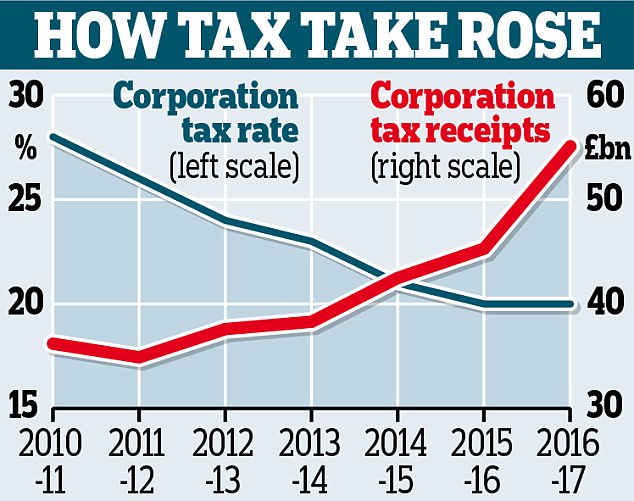
UK Corporate Income Tax Rate drop increased tax revenue by 50% from 2010-2016. Image courtesy Daily Mail.
 Letter to Britain