Home » Articles posted by Letter to Britain (Page 5)
Author Archives: Letter to Britain

Is the Myanmar Military Coup Any of Our Business?
I’m tempted to say straight off that what goes on in Myanmar (formerly Burma) is entirely the business of the Burmese people and that other countries don’t have any business interfering in the affairs of a sovereign country. And that’s fine, as far as it goes.
But there’s a shared responsibility that the world’s leaders have to the world’s citizens, which is the responsibility to ensure that what we call ‘normal civil rights’ are preserved regardless of which government or junta is in power.
Normally, this is expressed through the august offices of the United Nations, first by the UN Security Council (in emergency situations) and later, by the UN General Assembly.
In the case of Myanmar, the UN Security Council has barely commented, and the UN General Assembly hasn’t yet discussed the plight of Daw Aung San Suu Kyi, the deposed, or partially deposed leader of that country — who, it must be said, barely ‘ruled’ the country in the first place, and that, only with the tepid approval of the powerful Burmese military.
Was she the leader at all, one wonders? Or was it all a pantomime to placate democrats around the world concerned about the purity of democratic process everywhere, and in particular, Myanmar?
I think it was the latter, because as soon as Aung San Suu Kyi began to implement democratic reforms she found herself under house arrest along with some of her government ministers charged with spurious offences. An utterly predictable outcome.
If you didn’t see this coming years ago, either you’re not an astute observer of international politics or you’re incredibly naive.
The Burmese Regime Has Been Preparing for This Moment for Decades
Obviously, it’s been the plan all along: Placate world leaders by installing a weak president bereft of any real power; arrest the president if he or she decides to implement real democratic reforms; and then get ready to repel invasion by international ‘do-gooder’ nations, and then, via the use of pre-placed terrorist operatives around the world, destroy their attackers from within, to ‘teach them a lesson’ about ‘messing with Myanmar’. Anything is possible in war they say.
Which isn’t a bad way for a country to make a name for itself and a good way for a large number of extremely wealthy Burmese generals to enhance and extend their grip on power. Totally logical. Efficient.
And likely to succeed on account of the extended preparation time that Myanmar’s military has enjoyed courtesy of a global order busy with postwar rebuilding, the Cold War, and various wars and economic crises in the postwar era. And during the entire time, Myanmar was at the bottom of the international ‘To Do’ list.
As I said, anyone could’ve seen it coming.
The Moral (and Tempting) Choice is for World Leaders to want to ‘Bring Myanmar to Heel’
But how is that possible without getting Aung San Suu Kyi killed, or worse?
And how is it possible for the world to quickly create a powerful military coalition to enforce change in Myanmar — without hundreds or even thousands of military casualties courtesy of the Burmese military which has been spoiling for this fight for generations and now seems ready to engage and fight this battle on their own carefully prepared turf…
It’s a fight that the existing order is wholly unprepared for and one they could actually lose.
For example;
No one thought that North Korea could fight to a draw, a robust America nearing the peak of its power in 1950-53.
No one thought that France could lose the war in French Indochina (Vietnam).
No one thought that the USA (at the peak of its power, 1962-1975) and acting in concert with some of its allies, could lose the Vietnam War.
No one thought that the Cold War would end in a stalemate, irreparably damaging the economy of the former Soviet Union and driving American debt to a sky-high 82% of GDP. Generations from now, American citizens will still be paying the debt on the Korean War, the Cold War, the Vietnam War, the Gulf War, the Iraq War, the Afghan War, and countless brushfire wars, skirmishes, and ‘economic competition’.
No one thought that a single city (Mogadishu) could send the US Marines home damaged — not having ‘won’ their objective but not having ‘lost’ their objective either. And that was just one city.
And after all the billions spent to protect and defend American citizens, even the USA can barely protect itself from a tiny COVID-19 virus.
Myanmar’s military too, has been on an equipment spending spree for decades and it employs among the most sophisticated weaponry available in the world, its troops are trained to a very high standard, and Burmese generals seem to have no concern about losing thousands of their own citizens in civil war or international conflict. The fewer mouths to feed, the better. Unless they’re old enough to carry a rifle, that is…
It might be difficult for some to realize this, but the world has changed, and not just a little. The US, if it acted alone against the Burmese military in Myanmar, could lose that fight. Think about that for a minute. Think about how that would change the world.
What kind of world will we live in if upstarts like Myanmar can beat the mighty United States military and its allies (within Myanmar) and concomitantly wreak widespread (terrorist) destruction across America during and long after a war between the US allied group and Myanmar?
The world has changed people! Think about what you want to do, before you commit your country to a plan of action.
It’s Not What the Burmese Generals Know That Will Bite Them – It’s What they Don’t Know That Will Bite Them
Although the military junta has created a large and lethal army to protect their operation, there are other ways to get the citizens of Myanmar what they want and get what we want for Myanmar’s people. Peace and prosperity, along with civil rights.
One: Give the junta everything they want. Eventually, financial excess, unlimited political power and infighting will have the Burmese army consuming itself until there’s nothing left and then legitimate politicians can return to power and never again be challenged by their military after that negative experience.
Two: Cut off any travel by air or sea (only) to and from Myanmar. (A no-fly and no-sail zone along Myanmar’s entire coastline) Yes, plenty of trade could still be done via Myanmar’s land borders and this plan might merely inconvenience the ruling junta.
However, if they challenged America and it’s allies at sea, the junta would lose badly because naval power and air power happen to be Myanmar’s weakness. They have no real air force other than the latest-missile-equipped spotter-type aircraft and they have no real Navy other than small coastal patrol craft that are capable of sinking drug-runner boats. It must be emphasized again that Myanmar has a large and formidable (land-based) army, representing a huge capability for them.
So, when you go to war, you always want to fight the enemy on your own terms, doing that which your own side does best. You never want to fight the enemy on their strengths as that will dramatically increase your own casualty rate and the casualty rate of the civilians you’re trying to protect.
But cutting off air and sea access to Myanmar’s Bay of Bengal ocean frontage would embarrass the junta and let the citizens of Myanmar know that their plight has been heard and is being acted upon by a coalition of nations. (Hopefully, acted upon by all other nations)
And eventually, with enough billions of coalition dollars and enough coalition casualties, they would beat-down the junta enough that they would allow President Aung San Suu Kyi to rule Myanmar again. Unhindered this time.
Three: A long process; But so-called ‘Soft Power’ — employing diplomacy to work with the ruling junta to help it gain the same respect, maturity, and perspective that developed countries enjoy and employ to attain their goals — would work to raise the level of discourse among the generals that presently rule Myanmar. And this is what should’ve been happening all along, throughout the Cold War and especially since the end of that incredibly destructive (and wholly unnecessary) conflict.
Bringing Myanmar’s generals up to the same governance standards as the rest of the world is, by far, the best way to ensure peace, security, and prosperity for Myanmar and other countries in the region.
Helping Myanmar’s junta to become part of Myanmar’s solution instead of part of its own problem is the way to proceed.
Time for a Tony Benn quote: “All war, represents a failure of diplomacy.”
Let’s Plan Ahead and Get the Result We Want
Who doesn’t like peace and prosperity?
Who doesn’t like watching their hopes and dreams come true every day?
Everyone likes these things, and for good reason, they are the pathways that lead to happy and fulfilling lives for citizens and those things allow the robust economics that produce the reliable revenues that politicians need to deliver high quality government services to their citizens year in and year out.
So, let’s continue to plan for that in our own countries, and in the case of countries like Myanmar where governance is clearly still a work-in-progress, let’s help them plan for the same outcomes in their country by giving them the information and training they lack — thereby allowing their country to succeed — instead of them becoming yet another nightmare, another failed state that we all wind up paying for in blood and treasure.
Either this generation of world leaders are up to that task, or they aren’t. And if they aren’t, they haven’t learned from past mistakes and we’ll soon be at some kind of war in Myanmar. We shall see…

Significant Lives: Captain Sir Tom Moore passes away today, February 2, 2021
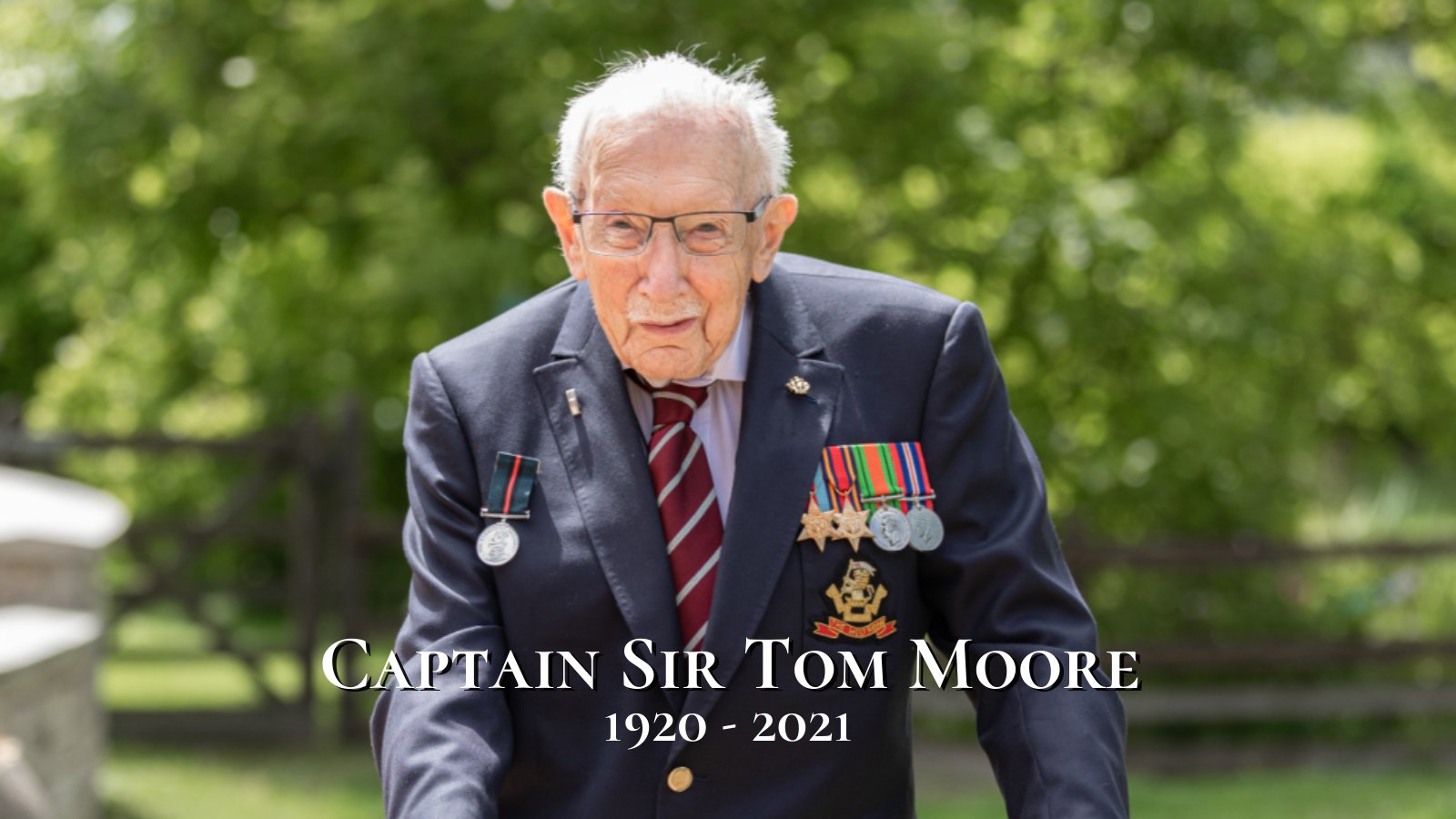
Captain Sir Tom Moore, 100-year old military hero who fought in WWII India and Myanmar (formerly Burma), who raised almost £33-million in 2019/2020 for NHS Charities Together, and who sang a chart-topping rendition of ‘You’ll never walk alone’ with Michael Ball in 2020, has passed away today, February 2, 2021.
From BBC — “In a statement, Prime Minister Boris Johnson said: “Captain Sir Tom Moore was a hero in the truest sense of the word. In the dark days of the Second World War he fought for freedom and in the face of this country’s deepest post-war crisis he united us all, he cheered us all up, and he embodied the triumph of the human spirit.
“He became not just a national inspiration but a beacon of hope for the world. Our thoughts are with his daughter Hannah and all his family.”
The flag above 10 Downing Street has been flying at half-mast in tribute and Mr Johnson has spoken to Mrs Ingram-Moore to offer his condolences.”
To read the full article on BBC, click here.

Why Countries Fail: The Politics of Dependency
Alright people, big topic, so put on your seatbelts and crash helmets, because I’m about to shatter your well-meant neo-liberal illusions as to why countries fail.
Hint: It’s all your fault.
Yes you — you paragons of democracy, you believers of humanistic values, you defenders of equality and equity, you bleeding-heart liberals — it’s all your fault.
“Why is it our fault, great voice communicating with us from the far reaches of the internet?”
Because for all your good-heartedness and do-gooderness, the very policies you’ve supported are the direct cause of most of today’s misery in developing nations around the world.
What happens out there in the real world is not what happens in wealthy jurisdictions like Aberdeen, Sheffield or Cardiff.
So, bear that in mind when Western military powers enter and control a country for the purpose of eliminating warlords, etc. — let’s say Somalia in this case, but it could be any number of African, Asian, or Arab countries, and stay there for any length of time — those countries operate under foreign military rule and the moment those foreign military units leave, the warlords re-emerge and resume their normal terrorist activities.
Which prompts many on-scene Western TV reporters to plead with their viewers to stop the government from removing their troops from that forlorn country. And good on them! It comes straight from the heart, there is no doubt that such reporters mean well and speak with years of experience in the region. I salute them for their very human response to what they must see as “America abandoning it’s allies” or “The West abandoning it’s mission to restore peace” or whatever.
But it isn’t what they think.
What’s really happening is that by sending powerful Western military forces into places like Somalia in the first place, the local population no longer feels they’re responsible for bringing peace and prosperity to their own country — after all, why do that when America shows up to do the job for them? And the longer the Americans and their allies stay, the more dependent local populations become upon ‘the Americans’ to operate their country.
It’s even worse than that.
What happens is that over decades of time powerful local lobby groups emerge that encourage some amount of home-grown violence to occur… so that ‘the Americans’ will return and restore order, and the population can then have another 5-10 years of relative peace and prosperity.
‘What’s wrong with that?’ Said every bleeding-heart liberal, everywhere.
What’s wrong with it is that by sending Western military units to ‘bring peace and stability’ to war-torn countries is that it prevents those populations from taking responsibility for doing it themselves.
Consequently, over generations of time, those populations work an unspoken deal with the warlords to cause trouble every time the Americans threaten to leave. (Warlords and their minions, by definition, are highly mobile and can easily slip across the border until the Americans leave) Not only that, but in cases where the Americans and their allies have already left, all it takes is a few dozen car bombs destroying a dozen city blocks (with many casualties) along with some carefully choreographed displays of civil disorder to get Western powers back into their country to restore order.
It’s nice that Western governments spend multi-billions per year in each war-torn country to restore order and bring about a peaceful standoff between the forces of terror and the forces of democracy. If only Western taxpayers knew the total combined cost of these military operations they might not think it so nice.
But it isn’t about the money, nor should it be.
The fact is, that by doing so repeatedly, the West is setting itself up for failure by sending troops to solve what are essentially, political problems. And political problems can never be solved by removing power from local populations, temporarily giving it to a Western military unit, and then, at length when that military power leaves, the situation again becomes highly unstable.
And it keeps happening again and again, all around the world.
The latest example of this is Somalia which has seen foreign troops come and go many times, yet as soon as they leave, it’s only a matter of time before the cycle of violence begins again — thereby necessitating yet another Western military intervention.
Today on BBC TV, another well-meaning reporter was pleading with the camera to keep US troops in Somalia because he (rightly) fears the situation there will deteriorate once the Americans leave.
And why will that happen? Because people there have forgotten how to govern. They’ve forgotten that they’re responsible for what goes on in their country, and they’ve forgotten that every developed nation has already gone through what they’re presently going through — and it seems a failure of human psychology that most countries can’t seem to get their act together until they’ve had a civil war or two. Including some Western countries.
Rather than shield countries from themselves by continually sending troops abroad to restore order, thereby preventing any form of organic self governance occurring, perhaps we should be awarding scholarships to their kids while our troops are still deployed in those countries — so that those students can live in the UK and experience an actual working democracy while taking their education — and hope that they study urban development or excellence in governance, thereby equipping them to return home with the knowledge to help set their country aright. That’s so much better than their local warlord teaching them how to fire an AK-47 at tourists and locals alike and to make improvised explosives.
Cheaper for us, AND better for them!
What’s not to like about ‘cheaper and better’?
What it will take to make this proposal a reality.
The UK can spend half of it’s foreign aid budget on ‘bullets’ or it can spend half it’s foreign aid budget on rescuing any child from a conflict-ridden Commonwealth country by giving them a proper education in the UK before returning them home.
Which is better, do you think?
In the short term, it’s easy to keep spending British treasure and blood to separate enemy combatants within developing nations. But over the long term it makes more sense to educate a new generation that there’s a better way to solve political problems than picking up an AK-47.
Thanks for your time, people. I wish you a wonderful week ahead.
 Letter to Britain