Home » 2018 (Page 5)
Yearly Archives: 2018

A Zero Tariff UK Economy
Think about it for a second. The thing we call Brexit is being held-up by a tiny item called tariffs. It’s ridiculous. (OK, there are some other things too, but for today let’s talk tariffs)
At the moment, the UK is still a dues-paying member of the European Union and is therefore obligated to charge the same tariffs as any other EU country, and such broad agreement on external tariffs, combined with low or no tariffs between members, or even standardized tariffs between members, is part of what makes up what’s commonly called a Customs Union.
When the UK exits the European Union it’s right to assume that the UK will no longer charge the same tariffs as the EU.
In fact, that difference is part of the problem between the EU and the UK in the post-Brexit timeframe, and businesses near the Republic of Ireland and Northern Ireland border may find themselves affected by this change-up.
How Would a Zero-Tariff UK Economy Work vis-à-vis the European Union post-Brexit?
What if the UK decides to embrace an economy where no tariffs are charged?
There would, of course, be people who complain (on the UK side) about a loss of tariff revenue for UK government budgets, while on the Republic of Ireland (RoI) side, businesses located near the border might worry their customers will drive to Northern Ireland (NI) to save 6.5% worth of tariff value on their purchases.
Which are immensely easy problems to solve!
How to Solve a Disparity in Consumer Prices (Due to Tariffs) Across an Uncontrolled Border
- Offer a rebate to Republic of Ireland businesses located within, say, 100 miles (160 kilometres) of the Irish border and such rebates would be equal to the (tariff portion of the) savings RoI consumers would enjoy by shopping in Northern Ireland. In this way, RoI shoppers won’t bother travelling to NI to save (usually about 6.5%) on the price of imported goods and consequently, RoI businesses won’t lose sales to the (then) zero-tariff regime north of the Irish border. We’re talking about small amounts of money on each transaction — but over the course of a year, especially for small ‘Mom and Pop’ businesses in RoI, it could add up and potentially at least, represent a hardship for those business owners. Who will cover the cost of the rebates? The UK, of course. Why would the UK government want to do that? It’s just one more irritation that the UK government can remove from the negotiating table to simplify Brexit. Such rebates might cost the UK government as little as £1 million per year. Of course, it might cost as much as £20 million per year. But, with so much to gain (a quicker and less hairy Brexit) the UK government could afford to pay the Republic of Ireland those rebates a full 10-years in advance at the beginning of each decade.
- For businesses in the EU that import from other countries and are required to charge tariffs on behalf of their government — all they need to do after March 29, 2019 is add the UK to the list of countries they must charge tariffs.
- For companies that export from the UK in the case where those goods are shipped to the EU or other countries — there’s no hassle with a UK zero-tariff regime because there are no UK tariffs to add to the final price — no matter where those goods land in the EU or wherever in the world they go after that.
- The same is true for goods that originate in America (for example) but are shipped through the UK before being shipped on to the EU. Whatever the price of the item from America + zero tariffs added by the UK = landing in the EU with only the taxes or tariffs that originated in America. The UK adds nothing in the way of tariffs, nor takes anything away from those tariffs. The term for that is revenue-neutral tariffs.
It’s so easy when you know how!
How Could the UK Recover Lost Tariff Revenue and Pay the Proposed Irish Tariff Rebates?
There would be two costs for the Chancellor of the Exchequer to cover:
One would be the loss of tariff revenue which would represent a large annual cost — and the other would be the relatively small cost of rebates to RoI businesses located within 100 miles (for example) of the Irish border.
a. For as long as the UK has been in the EU Customs Union, consumers have unknowingly paid the cost of tariffs on goods imported from outside the EU. In some cases the tariffs involved are quite low, but in other cases EU countries are required to charge up to 18% tariffs on certain goods coming into the EU28. All EU consumers pay an average of 6.5% more for goods imported from outside the EU due to those EU tariffs. But as soon as the UK leaves the EU Customs Union it would no longer charge EU tariffs and the cost of imported goods in the UK would fall by an average of 6.5%. Which is a good thing, except that the Chancellor of the Exchequer would need to cut spending by that total sterling amount or, add 1% (or less) to the national sales tax to make-up for that lost revenue. Most Britons won’t even see the difference. But if you’re a Briton who buys a lot of imported goods you’ll be slightly better off.
b. If you’re a UK business, it’s one less piece of paperwork you have to deal with and one less revenue stream you must collect on behalf of HM government.
c. If you’re the Chancellor of the Exchequer, you’ll lose millions in tariff revenue, but you’ll gain even more from the (less than) 1% addition to the national sales tax. But even more important, you’ll save millions of pounds in spending to oversee, police, and navigate all that tariff collection. Those tariffs don’t get collected by themselves! Nor does every business remember to forward those tariff revenues to the government on time, etc. Nor will the Chancellor be required to keep abreast of competitor nation tariff structures and constantly adjust tariffs for the UK to remain tariff competitive, nor will the Chancellor be required to notify the WTO about tariff changes. Because, no tariffs!
A Word About the WTO
The World Trade Organization (WTO) is a great organization that was created to ensure countries play fair with each other, especially on tariffs and on the dumping of goods at outrageously low prices, thereby harming the country importing their goods. And if you’re a developing country, you definitely want to be a WTO member as the WTO will protect you from larger, more aggressive countries and their powerful transnational corporations.
However, it makes rules in accordance with its membership wishes and some of those rules may surprise you.
WTO rules do not apply to trading partners that charge tariffs lower than the WTO tariff schedule (which was recently increased to an average of 6.55% on a long list of goods) therefore, trade deals can be done more quickly without WTO tariff regulations to complicate things.
The WTO won’t arbitrate between non-WTO members, nor will it intervene where countries charge tariffs that are lower than the WTO tariff schedule. Nor will it involve itself where two countries have a dispute within a free trade agreement previously agreed by both sides — unless requested by one or both parties to mediate disagreements within that free trade agreement.
In short, countries that don’t charge tariffs have no dealings with the WTO, they owe it nothing, and they have no tariff disputes. (Because they have no tariffs to argue about)
Summary
Many things come together beautifully for the UK were the government to decide to operate a tariff-free economy.
Not only would Brexit be streamlined, the Irish border situation becomes simpler to settle, relatively small rebates can offset any hardships for RoI businesses located close to the Irish border, CEO’s from other countries would appreciate the ease of doing business in the UK, any losses in tariff revenue for HM government can be offset by a (less than) 1% increase in the national sales tax, and free trade agreements become simpler to negotiate.
The UK wouldn’t need to re-apply to become a WTO member, nor would it fall under WTO jurisdiction in trade matters, nor would the UK need to pay annual dues to the WTO.
And imported goods in the UK would become cheaper by an average of 5.5% roughly speaking (dropping the 6.5% average tariff on imported goods + 1% national sales tax increase on all goods = 5.5% cheaper on imported goods) which can help consumers in regards to their discretionary spending.
The government would save millions of pounds sterling annually because it wouldn’t need thousands of workers to work in the Treasury’s tariff section, adjusting tariffs, comparing tariffs, ensuring tariffs are properly implemented, ensuring that tariff revenue is properly submitted to the government by UK business, dealing with the WTO, and handling lawsuits caused by disagreements over which tariff schedule must be applied on a given product. And many more miles of red tape than that, that the UK government could forget about forever.
Just another list of the benefits of Brexit, my friends! Happy weekend!
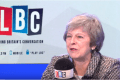
PM Theresa May Takes Calls on LBC: November 16, 2018
UK Prime Minister Offers Her Draft Brexit Proposal and Chaos Ensues!
Since Prime Minister Theresa May offered her 585 page draft Brexit document to the UK Cabinet, she has lost 2 Cabinet officials and 5 junior officials, with rumblings of perhaps double that amount to submit their resignations by Monday of next week, and further on this, ERG spokesman Jacob Rees-Mogg has submitted a Letter of No Confidence to the Conservative party executive.
It may be that Jacob’s letter to the party executive is the first of many such letters and according to the rules, once 48 such letters are received the party can then trigger a leadership contest to replace the Prime Minister. Which would be bad timing in the extreme for anyone who cares about obtaining a decent Brexit.
There is of course, only one problem with the draft document that Theresa May has proposed (and apparently the EU27 have approved) and it is that there is no mechanism for the UK to leave the proposed Customs Union before the Implementation Period ends in 2020, nor at any time following the Implementation Period.
Which means the UK will be stuck in the EU’s Customs Union and subject to their regulations indefinitely with no way out. A complete non-starter.
It’s been pointed out that it would be more difficult for the UK to leave that neverending Customs Union agreement than to leave the EU using the Article 50 clause of the Treaty on European Union. Scary thought.
The Present Chaos Will Continue Until PM May Makes a Move – Any Move!
Her choices are limited, but she must act quickly to minimize the slow motion car crash that is HM government at this time.
- She could resign, which is a terrible idea. Theresa May is the best person and is the person Britons voted for to carry out Brexit. Not only that, she’s more informed about Brexit than any of her ministers, and has been living in the eye of the storm moreso than any other House of Commons member since the EU referendum.
- She could do nothing and just let the present chaos continue, which is an even worse idea. More Cabinet Secretaries, ministers, department heads and even junior staff are poised to quit their posts in the coming days in the absence of positive steps by Theresa May to remedy the failures of the draft Brexit document.
- Theresa May could hit the talk shows to explain her Brexit proposal more fully to Britons, which is somewhat worthwhile, but that conversation will forever come back to the fact that there is no mechanism for the UK to get out of the EU Customs Union. Ever. The UK will forever be chained to the EU by the present draft agreement — even if Italy and Greece suffer a massive economic crash and take the whole works into a disastrous and long-lasting economic depression. In which case, so much for the Brexit dividend!
- The Prime Minister could put the present flawed agreement to a free vote in the House of Commons, which would prove to her how insufficient this draft proposal really is. (I don’t think she gets it) Remember, a free vote allows MP’s to vote using their own conscience and in such votes party whips focus on nothing but getting MP’s to the chamber so they don’t miss the vote. I doubt that it would muster 50 votes out of 650 at this point. Maybe much less, if she waits a week.
- Theresa May could put the present flawed agreement to a normal vote in the House of Commons and policed by party whips and it still wouldn’t pass. Not only that, she would then face the double jeopardy of more Cabinet resignations and the body politic even more frustrated with their politicians. The media… would love it though! It was nice to see them so happy to have some exciting news to report since the moment the Prime Minister released her draft proposal.
- The Prime Minister’s best course of action would be to add an end date to the document, present it to her Cabinet for their approval, and the next day present it in the House of Commons for a free vote — and it would likely pass with flying colours. However, it might not pass with the mandarins in Brussels. But a little bit of moxie is what is needed at this time, not more appeasement. I can’t stress enough, this option is the best option by a very wide margin. The EU is just going to have to like it — or make a counter-proposal — something they’ve done precious little of during the Brexit process. And why would they? So far, it’s been Theresa May negotiating with Conservative MP’s, with Labour MP’s, with her own Cabinet, and with herself. It’s time to put the EU side on the hotseat. At the very least, it will prevent an ongoing political bloodbath for Ms. May, it will help her to keep her job, it will put some of the responsibility for a successful Brexit on the shoulders of the EU side (as it should be, as it takes two to tango) and it is the most efficient way of getting past the present disastrous moment.
- If Theresa May feels she can’t do as I suggest in #6 above, she needs to resign OR she needs to declare that this draft proposal was stillborn and we are now onto a Hard Brexit which would save British taxpayers £40 billion. Or as much as £51.5 billion which is the number that is buzzing around over the past few days.
In the present political climate and with dissatisfaction by voters from all parties growing by the hour, Prime Minister May’s worst option is to do nothing.
She must act decisively, for her career, for her party’s fortunes, and for the good of the country. Sitting this one out just isn’t an option.

Theresa May’s ‘Hotel California’ Brexit Proposal
So, welcome fellow travellers… to the EU’s very own ‘Hotel California’ where, apparently, ‘you can check-in any time you like, but you can never leave’.
But of course we know that the UK can leave the European Union — that is why the UK government triggered Article 50 of the Treaty on European Union that allows a country to leave the bloc.
Then, we found out that it was going to cost £40 billion (and suddenly, as of yesterday, we find out that it may cost as much as £51.5 billion) Of course, nobody knows what the money is for. The UK taxpayer is supposed to pay it without asking any questions.
Then, we found out the EU was trying to take Northern Ireland by stealth, tying it to the EU Customs Union forever (while the rest of the UK was no longer allowed to remain within the Customs Union) as the first step of Northern Ireland’s assimilation into the EU.
Then, the EU having failed at trying to pry Northern Ireland from the United Kingdom using the ol’ distract ’em with a Customs Deal shell game, Theresa May was (again) summoned to Brussels and promptly returned with a deal that looked for all the world like it was written by the EU’s very own negotiators — complete with a clause allowing the entire UK to stay within the EU’s Customs Union — but with no mechanism for the UK to ever leave that Customs Union. Forever is a long time.
Which brings us to the great and timeless song by the Eagles… Hotel California!
Hotel California by the Eagles
(The last half of the song is paraphrased by Letter To Britain for your listening pleasure. Feel free to play the video and follow along with the ‘updated’ lyrics)
Welcome to the European Union
Such a lovely place (such a lovely place)
Such a lovely face.
They livin’ it up at the EU down in Brussels
What a nice surprise (what a nice surprise), bring your alibis.
Mirrors on the ceiling,
Billions pound sterling on ice
And Theresa May said, ‘we are all just prisoners here… of our own device’
Deep in Brussel’s chambers,
They gathered for the sterling feast
They stab the UK with their steely knives,
But they just can’t kill Britain’s spirit.
Last thing smart people remember, we were
Running for the door
We had to find the passage back to the place we were before
‘Relax’ said Barnier the EU’s man tonight,
‘We are programmed to receive.
You can check out any time you like,
But you can never leave!’
All of which means that Theresa May and the rest of HM government should be very careful about how they proceed towards the full and complete Brexit that 17.4 million Britons voted for in June 2016.
Because if this is the only deal on offer, even Remainers will understand that the so-called ‘No Deal’ Brexit is the better option. And, as this is the only offer approved by the EU apparatchiks at this time, a No Deal Brexit must now become the default option for the United Kingdom.
 Letter to Britain