
Is Apology Due From Those Who Invest in Foreign Tax Havens?
Since revelations have surfaced that billions of pounds sterling have left the UK for foreign tax havens there have been calls for people using foreign tax avoidance schemes to be ‘guilted’ into making a public apology.
Labour leader Jeremy Corbin suggests that anyone using an offshore tax haven should apologize to the country.
One British person who has millions invested in the Cayman Islands is the acting Queen of the United Kingdom. We don’t know if Jeremy Corbin wants Elizabeth Regina to apologize to the British public for investing overseas, and we assume he knows the Queen isn’t required to pay tax under British law, but does so voluntarily.
On a more serious note, the Labour leader is quite right to be appalled at those who, having been raised and who earned a good living in one of the best countries in the world, would then take their money out of the country that made them rich to invest it offshore!
Why would they do it? Because they can make higher returns on their investment (at higher risk) and it’s a way for companies to lower their overall tax burden, and individuals can hide money from family members.
Simple Solutions Work Best
Like taxing any British sterling that leaves the country at 20 percent. That way, HM tax office collects significant revenue and the government can better fund schools, hospitals and roads, etcetera.
Even so, some will choose to invest overseas because they can earn 50% returns or better in so-called ‘Frontier economies’ and even having paid such a (proposed) tax they’ll still earn 30% or better.
For each individual or business the first 100,000 pounds sterling taken out of the country shouldn’t be taxed, but everything after £100,000 individuals and companies should be required by law to pay the 20% tax.
By using this high-ish threshold, Mom, Dad and the kids can go holiday-making in foreign countries and not have to pay the foreign withdrawal tax, perhaps in their entire lifetime.
NOTE: For the first £100,000 worth of withdrawals it could go in Dad’s name, then Mom could use her lifetime 100,000 pounds foreign withdrawal limit. Therefore, a family unit would have a combined lifetime limit of £200,000. Once they hit that threshold, thereafter they would pay 20% tax on each pound that they send or spend outside the country.
On a Separate Note; 19 Billion of Them, Actually
Britain loses about £19 billion annually on so-called ‘Foreign Remittances’ on account of foreign-born workers sending their money home to their families. Who could blame them?
Yet it’s a serious problem, but as previous governments haven’t figured out a way to stop it, it’s never been addressed.
SIX PERCENT of Thailand’s GDP comes from foreign remittances, for just one example, and many other countries count foreign remittances as an important part of their GDP.
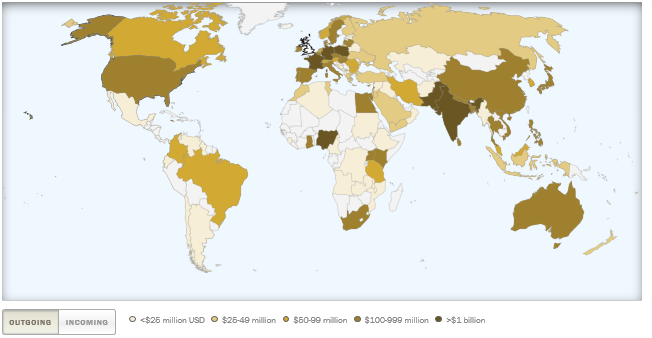
Although foreign remittances are only rough estimates, at least $24,878,000,000 in remittances were sent from the United Kingdom to other countries in 2015 alone. The actual amount could be much higher. Image courtesy of Pew Research.
Therefore, expats should be able to send the first 100,000 pounds home without paying the 20% tax — but after that they’re draining the country of money(!) so they must begin to pay the tax when they hit the £100,000 mark.
The trick is to be fair with foreign workers who work hard to earn their money, but to stop the UK being unduly taken advantage-of which has been happening for decades.
The government relies on voluntary notifications of such foreign remittance sending, so the number is pegged at £3.2 billion pounds sterling on the GOV.UK website.
Money exchange units such as Western Union, PayPal, World Remit, and banks and trust companies know the real numbers, but interestingly, not one of them have ever been called to testify to the House of Commons about the gross total amounts transferred out of the UK annually. Not once…
It’s Either Treason Or it Isn’t. It Can’t be Both
With a 100,000 pound threshold, my tax idea isn’t aimed at *normal citizens* nor is it aimed at *normal expats* sending a few thousand pounds home to their families — it’s aimed at the fat cats, at the criminal syndicates, and at wealthy people who earned or inherited their fortunes in the UK who should be deeply ashamed they’re not re-investing in the country that made them rich.
To me, such people should have a fair trial on Friday and if they’re found guilty, let them be found guilty of treason (for that’s what it is, IMHO) and be shot dead on Monday — but that law isn’t likely to be passed in the UK House of Commons anytime soon.
It’s Been Going On for Decades; What to Do Now?
Perhaps we could say; ‘What’s gone on before now we can leave aside, as there weren’t sufficient laws nor guidance for individuals or companies, and frankly, in past decades the taxation rates were grievous to be borne by both individuals and companies’ — but at this late date we’re going to create new laws (that don’t need to be complicated!) to counter the astonishing, continuous, and increasing run on the country’s wealth.
Everything is Nothing – Unless You Can Accurately Quantify and Qualify It
Therefore, the UK government should call banking experts and wire transfer companies to testify (under oath) before the House of Commons as to the general extent of the foreign remittance problem and to quantify and qualify the offshore tax shelter monies that leave Britain annually for foreign tax havens.
How to Plug a Leak
The goal should be to compel banks and wire transfer companies to become ‘part of the solution instead of part of the problem’ as the government needs the information — the banks and transfer companies have it; the government doesn’t! — and nobody else on the planet could begin to figure it all out.
Getting a handle on this decades-long travesty (drum roll, please) could provide a double-boost to the UK economy by;
- preventing multi-billions of British sterling from leaving the country by making it uneconomical,
- and by capturing billions in tax revenue on money still determined to leave the country,
- and allowing the government to earn enough revenue to lower the corporate tax rate to 14.5% (to match Canada and other competitive nations’ corporate tax rate)
- which would drive investment to the UK in the billions, and perhaps a trillion pounds over 10 years.
See what plugging a leak can do for the United Kingdom?

Foreign tax havens. Image courtesy of Cayman Financial Review. Click the image to visit Cayman Financial Review for general information on foreign tax havens.

Should the UK Have an Opinion on Catalonia?
As the UK remains a fully paid-up member of the 28-member European Union, it seems fair that the government should have a position on Catalonia’s recent move toward greater autonomy. Which in recent weeks, has grown beyond simple autonomy within the Spanish federal government architecture to seeking full independence, but the attempt has since been knocked down by the Spanish authorities.
Had the UK passed the Brexit threshold by now, it would be difficult indeed for the British government to have any public opinion at all as it then becomes a very different thing. It’s fair comment to opine on the internal politics of a fellow EU member state, but it is quite another for a non-member to criticize the goings-on in a foreign country.
For that reason, it’s well within Theresa May’s purview as the Prime Minister of a paid-up member of the European Union to comment on issues Catalonia.
Nigel Farage MEP certainly didn’t hold back from informing his viewers about his opinions on the Catalonian situation and it’s difficult to find flaws in his argument.
Certainly, it was a tragedy that 900 mainly peaceful protesters were injured and/or arrested by Spanish federal police, although many of those charges against protesters may be dropped in exchange for the much more serious charges against the police being dropped. Look for this to happen on a case-by-case basis. Many of the police are reputed to have used excessive force against the (probably annoying, but otherwise peaceful) protesters.
Until such times as Britain is no longer an EU member state, the UK and its citizens have every right to comment on the unfortunate Catalonian situation, but after Brexit I hope the government feels constrained about commenting on what will then be, a comment on the internal affairs of a sovereign bloc (the EU) a sovereign nation within the EU (Spain) and a state within that nation (Catalonia)
“What Goes Around, Comes Around”
This has been true since the universe began and were the British government to attempt to unduly affect the outcome (either way) in Catalonia, eventually it could work against the United Kingdom and conceivably against the Commonwealth, as there are rumours from time to time about disaffection among jurisdictions of either entity.
Therefore, it’s best for the UK government to comment in good form only and avoid trying to make political hay against the EU bloc simply because we may have other frustrations with them. (Hey, they’re frustrated too. It isn’t a one-way street. Let’s just get the Brexit done and not unduly antagonize the EU Parliament or its individual member states in the meantime, because that works better for the UK in the long run)
As a Member of the European Parliament and as a citizen of the United Kingdom, Nigel Farage has much more leeway to comment than the government, and his recent talk show brings up some fascinating points about Catalonia. Take a few minutes and watch Nigel take calls from all over the world about the attempted Catalonian secession.
 Letter to Britain