
Brexit Begins: March 29
by John Brian Shannon | March 20, 2017
UK Prime Minister Theresa May says she intends to proceed to exit the EU on March 29. Brexit begins…
Theresa May will trigger EU withdrawal talks under Article 50 on March 29, Downing Street has announced
The Prime Minister’s letter officially notifying the European Council of the UK’s intention to quit will set in train a two-year negotiation process expected to lead to Britain leaving the EU on March 29 2019.
Britain’s ambassador to the EU, Sir Tim Barrow, informed the office of European Council president Donald Tusk on Monday morning of the Prime Minister’s plans.
The Brexit Bill – officially called the European Union (Notification of Withdrawal) Bill – was given the green light last week after being signed off by the Queen. — metro.co.uk
First on the agenda will be whether May can negotiate unrestricted access to EU markets for Britain, and how much access European Union citizens and industry will have to the United Kingdom. It’s likely to require a substantial amount of time, patience, and great diplomatic skill on both sides of the negotiating table.
Of secondary importance will be the decisions taken on customs and immigration. The EU has lost control of its external border as the Schengen Area borders effectively collapsed when millions of Syrian, Middle Eastern and African refugees began streaming into the southern European Union.
And the third negotiating point will likely relate to the status of EU citizens who live and work inside the UK, and of Britons who work or retired in the European Union.

Brexit Begins in Britain on March 29, 2017. Image created by Samankashwaha.
In total, some 3.3 million EU citizens live in Britain, but nobody has kept an accurate count of this (nobody!) nor has any government agency kept count. In the European Union it’s thought that 1.1 million Britons live or work on the EU side of the border. Except that nobody knows for sure. One side is just as broken as the other. Facepalm!
Experts and commentators unanimously agree that it will take years, perhaps 10-years or more to hammer out an agreement on all the current issues between the European Union and the United Kingdom. Let’s hope that cooler heads prevail and that we don’t add mountains of new issues to the existing list of items to be discussed and resolved. It’s going to be a monumental work as it is.
It’s important to remember that in a ‘Win-Win’ relationship, whatever gets solved, becomes a ‘Win-Win’ for the politicians involved. Which is handy, come the next election.
While the UK side has seemed apprehensive and tentative at times, particularly in the immediate aftermath of a June 23rd EU referendum result which saw 52% of voters choose to ‘Leave’ the European Union — the EU side has taken an increasingly hostile position — as if senior EU politicians have taken it personally that Britons voted to ‘Leave’ and as a voter attack on their cherished institutions.
However, if European Union membership were that wonderful, not one person would have considered leaving the EU… but the simple fact is, more than 17 million British voters elected to leave the EU governance architecture.
And no matter what — no matter what! — the will of voters always trumps the will of politicians. We’ve seen it time and again throughout history. Yes, totalitarian states can ‘hang on to power’ for a time using the full resources of the state, until such times as the state collapses and the strongman is overthrown, but such things are supposed to be impossible in democratic states.
Let’s hope that the European Union lives up to its high democratic ideals and allows nations to leave as easily as they join!
On the bright side, it could be that by voting to Brexit the citizens of the United Kingdom will have assisted the EU to take the concerns, disappointments and perceived slights of member-state citizens more seriously in the future. Otherwise, Brexit will simply become one part of a much larger process, resulting in the eventual dissolution of the Union. And that would be a shame.

Indyrefs Until Nicola Gets the Answer She Wants
by John Brian Shannon | March 14, 2017
Q: How many Scottish Independence referendums will there be, Mum?
A: As many as it takes for Nicola Sturgeon to get the answer she wants, dear…
Which will be more than the advertised ‘once-in-a-generation-vote’ of the original referendum on Scottish independence.
“Senior Nationalists called the referendum a ‘once in a generation’ event. Alex Salmond and Nicola Sturgeon both signed an agreement with stating they’d respect the result. Ms Sturgeon went on the record saying she ‘wouldn’t have the right’ to ask the question again unless views changed.
These turned out to be hollow promises, every one.
Absolutely everything the SNP has done from referendum day to now, has been geared towards engineering another vote.
Despite losing her majority in May, by June Nicola Sturgeon was back at it – using the EU referendum as a catalyst. Instructing officials to start drafting another independence referendum Bill within four hours of the Brexit result.
It is unjustified, infuriating and wrong. It denies the democratic verdict of the 2014 referendum. It breaks Nicola Sturgeon’s own word. It ignores every bit of polling evidence which suggest Scots don’t want another referendum, and that Brexit hasn’t materially changed views on independence.
And it is terrible for Scotland’s economy.” — The Telegraph
In the space of only 30 months and against her own promises, the First Minister of Scotland Nicola Sturgeon is proposing another referendum on Scottish independence (Indyref) in the hopes of getting the results she missed by a healthy margin during the last Indyref held in September 2014.
Here are the 2014 results as recorded by the BBC


Breakdown: Here is the referendum result by Council.
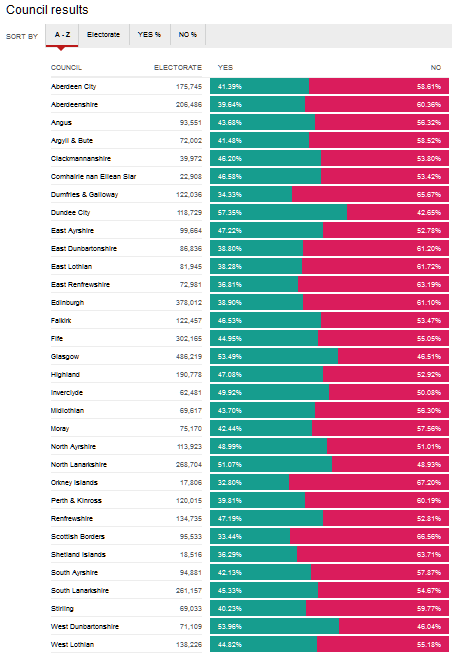
With 84.59% of eligible voters turning out to vote in the referendum, the ‘No’ result can’t be blamed on poor voter turnout. It must be something else.
Maybe it’s that the Scottish people know they have ‘a good deal’ with the rest of the United Kingdom, or that they are a people who respect the many and historical links between Scotland and the other members of the UK and Commonwealth, or that they feel their future is inextricably linked with everyone else on the island, or that the case for Scottish independence simply wasn’t compelling enough. It could be all of that, and more.
Whatever their reasons, 55% of eligible Indyref voters in 2014 chose to stay in the United Kingdom.

The question that hasn’t been answered by Nicola Sturgeon;
What’s changed ‘the case for’ Scottish independence vs. 30 months ago?
Something must have changed to make Nicola think there would be a different referendum result or she wouldn’t be calling for a second referendum on Scottish independence.
The Scottish people and the other members of the United Kingdom are entitled to know exactly what has changed that would suggest a different Indyref result.
Otherwise the people of Scotland will simply duplicate the time and expense of a second referendum to arrive at a similar result.
Inquiring minds (and the people paying for, and affected by) a second referendum deserve to know…
Related Article:

Should Theresa May Guarantee the ‘Rights’ of EU Citizens Living in Britain?
by John Brian Shannon | March 6, 2017
Many of Britain’s finest newspaper columnists, editors of some of Britain’s most prestigious publications, and even some British MP’s are calling for Prime Minister Theresa May to ‘guarantee’ the so-called ‘rights’ of EU citizens who live, work and play in the United Kingdom.
This might seem a noble idea at first — however, there is no ‘right’ for anyone to live or work in Britain — other than the rights that have been earned by British citizens. It was Britons who built the great nation we see today and they did it through hard work, determination and innovation. And older British citizens suffered through WWI, WWII, the Cold War, and various social upheavals and recessions to build the modern Britain. Well done, lads and ladies!
Why should similar ‘rights’ be conferred upon the citizens of other countries simply because they work, study or retire in Britain?
Do Britons have those ‘rights’ in the EU or in other countries? Why not?
The answer is; British expats will never be granted similar ‘rights’ to citizens in other countries no matter how long Britons live there. So why does this question keep coming up?
“It would be convenient for EU citizens and companies that EU citizens should be granted similar ‘rights’ to British citizens.”
Well yes, of course it would. And I view statements like that in the same context as;
“I would like a free Aston Martin delivered to my door today — and fresh-baked French bread delivered each morning.”
Righto. Allow me to get right on that.

Why not just give EU citizens who live in Britain a free Aston Martin instead of free virtual citizenship and be done with it? It’d be cheaper in the long run.
How many other countries offer such ‘rights’ to the expats in their nations — as is being proposed by some in the UK?
Tourists are a completely different matter of course, and they are welcome anytime for stays up to 90 days. (This should be a standard rule in every country)
Britain’s tourism industry is a thriving enterprise — but it isn’t doing half as well as it might simply because Britons don’t see the attraction of Britain through the lens of foreigners. It’s a truly magnificent country that ranks first on practically every traveler’s bucket list.

The World’s Most Visited Cities in 2016
Britain’s population of 65 million pales in comparison to Europe’s 439 million (for a pan-European total of 504 million in 2016) and it isn’t like continental Europe is running short of land, unlike the island nation of Britain. So why is London such a draw for EU citizens? Why do so many Europeans want to live in the UK?
Are there really 8 million foreigners in Britain?
According to widely circulated media reports there are 3.3 million EU citizens living in the UK, mostly in London, and without a firm border there’s likely to be double that amount by 2025 if Britain decides to award free (virtual) citizenship to EU citizens. There are many more non-EU nationals living in the United Kingdom but no UK government department knows that number.
Our Government has absolutely no idea how many EU citizens live in the UK but The Migration Observatory reckons it will take 140 years to process the 3.5 million EU citizens presently in the UK who may seek permanent residence.
It’s a privilege, not a right
It’s a privilege for anyone to visit, work, or to retire in Britain — not a right.
If some EU citizens are miffed at that statement, they should know that many Britons will rejoice when they return to their former neighbourhoods (which are presently overpriced because 3.3 million high-spending EU nationals live in London) and return to their former jobs when those EU citizens leave the UK.

The Most Expensive Places to Buy a House in London 2016
I sincerely and respectfully urge Prime Minister Theresa May to give careful consideration to granting the citizens of any country any special ‘rights’ unless identical rights are legislated in those other countries for Britons. Although it seems reasonable to me that a slightly more favourable visa regime could be passed by the UK House of Commons for the citizens of Commonwealth nations.
But for nationals of any other bloc or nation, a yearly and easily renewable worker or consultant visa, student visa, retiree visa, family or medical reasons visa, or academic visa should be requiritur per UK imperium for those who plan to stay in the UK for longer than 90 days (e.g. ‘not a tourist or diplomat, but an expat’) and it should be available online for £100 annually at GOV.UK.
Do the math: Assuming 8 million expats x £100 annually = £800,000,000 in annual government revenue. Which would almost cover the costs of monitoring and protecting those 8 million foreign nationals, and covering their share of infrastructure costs.
Millions of Britons lived (and many died in combat) to build a better Britain, let’s not give it away for the sake of corporate convenience to those who won’t ever fight for Britain.
“Don’t it always seem to go, that you don’t know what you’ve got till it’s gone; They paved paradise and put up a parking lot!” — Joni Mitchell
Related Articles:
- Ministers urged to protect rights of EU citizens in UK (BBC News–Mar 4, 2017)
- 6 Reasons Why Protecting The Rights Of EU Nationals In The UK BuzzFeed News–Mar 5, 2017)
- Theresa May must guarantee the rights of EU nationals in the UK (Business Insider–Mar 5, 2017)
- Theresa May faces fresh calls to guarantee rights of EU citizens (The Sun–Mar 4, 2017)
- Gove calls on May to guarantee EU citizens right to remain in UK (International–The Guardian–Mar 4, 2017)
- EU nationals in UK should have future rights guaranteed, MP’s say (International–Gibraltar Chronicle–Mar 5, 2017)
 Letter to Britain